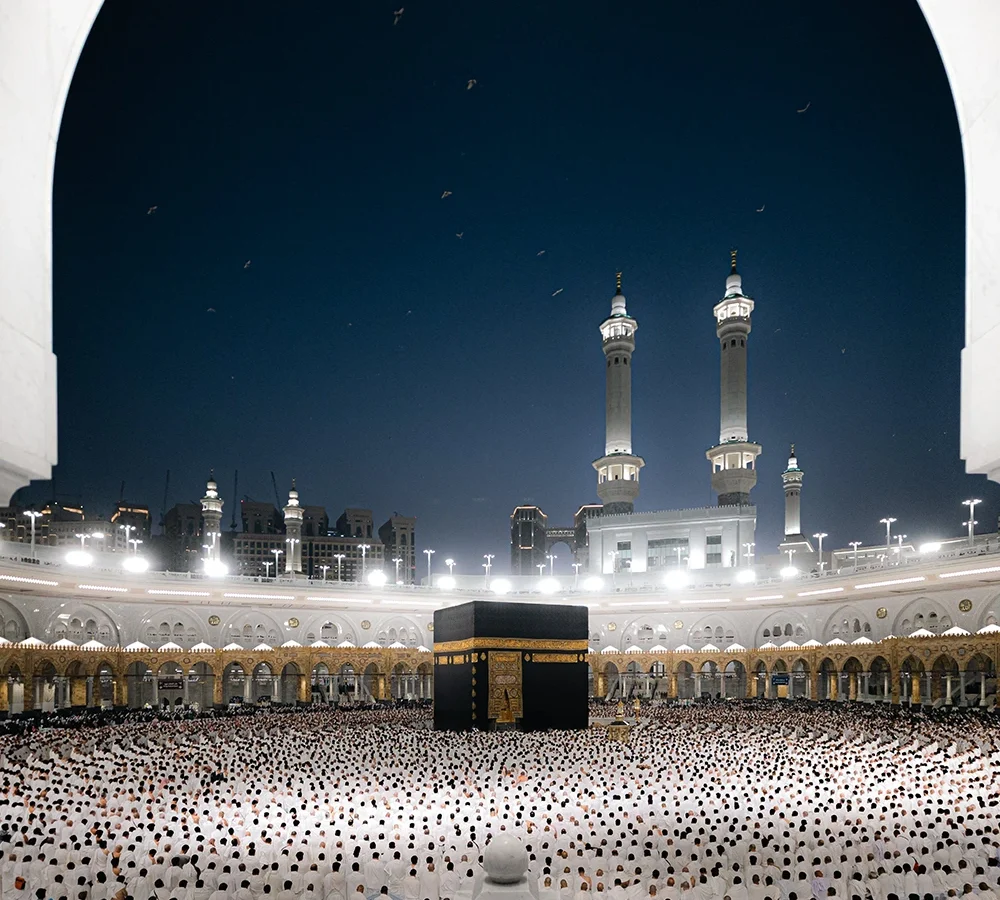
Umrah is short and simple once you know the order. This guide walks you through each step, from leaving the UK to cutting your hair, with the duas you need in Arabic, transliteration and English. Keep it open on your phone in the Haram.
The four parts of Umrah: 1. Ihram (with the intention) at the miqat. 2. Tawaf, seven circuits of the Kaaba. 3. Sa’i, seven laps between Safa and Marwah. 4. Shaving or shortening the hair. Most people finish in 3 to 5 hours.
Why Umrah matters
The Prophet ﷺ said that one Umrah to the next is an expiation for the sins in between (Bukhari 1773, Muslim 1349). He also said that Umrah in Ramadan carries the reward of Hajj (Bukhari 1782). Go with a clean intention: you are answering the call of Allah, not ticking off a holiday.
Before you leave the UK
- Check your passport is valid for at least 6 months and get your Umrah visa (eVisa or through your agent).
- Install the Nusuk app. You use it for permits, including the Rawdah in Madinah.
- Get the meningitis ACWY vaccine and keep the certificate.
- Learn the steps and duas in this guide, and settle any debts or disputes before you travel.
- Pack your ihram in your hand luggage if you fly straight to Jeddah. Our packing list covers the rest.
Open the men’s and women’s packing lists
Travel dua (when you set off)
سُبْحَانَ الَّذِي سَخَّرَ لَنَا هَذَا وَمَا كُنَّا لَهُ مُقْرِنِينَ، وَإِنَّا إِلَى رَبِّنَا لَمُنْقَلِبُونَ
Subhanal-ladhi sakhkhara lana hadha wa ma kunna lahu muqrinin, wa inna ila Rabbina lamunqalibun.
Glory be to the One who has placed this at our service, when we could not have done it ourselves. And to our Lord we will surely return.
Quran 43:13-14, Muslim 1342
Step 1: The miqat
The miqat is the boundary you must not cross for Umrah without being in ihram. Where it falls depends on your route.
- Flying straight to Jeddah: your plane crosses the miqat before landing. Change into ihram at home, at the airport or on the plane, and make your intention when the crew announce the miqat (usually 30 to 60 minutes before landing). Jeddah airport is inside the miqat, so do not wait until you land.
- Going to Madinah first: no ihram on the flight. When you travel from Madinah to Makkah, put on ihram at Dhul Hulayfah (Masjid Abyar Ali), just outside Madinah.
- Already in Makkah for a second Umrah: go out to the nearest point outside the Haram boundary, usually Masjid Aisha (Tan’eem), and make your intention there.
Step 2: Ihram and the intention
Before ihram: clip your nails, remove unwanted hair, take a full bath (ghusl) and men may put perfume on the body, not the ihram cloth. Then change.
- Men: two white unstitched sheets, one around the waist and one over the shoulders. Sandals that leave the top of the foot uncovered. Head uncovered.
- Women: your normal modest clothing in any colour. Do not cover the face with a niqab or wear gloves. A loose cloth may be lowered over the face near men.
Pray two rak’ah if it is not a forbidden time, or make the intention after a fard prayer. Then make your intention in your heart and say:
Intention for Umrah
لَبَّيْكَ اللَّهُمَّ عُمْرَةً
Labbayk Allahumma ‘umrah.
Here I am, O Allah, for Umrah.
Muslim 1232
Worried something might stop you finishing, such as illness? Add: Allahumma mahilli haythu habastani (“O Allah, I leave ihram wherever You stop me”). Bukhari 5089, Muslim 1207.
Step 3: The talbiyah
From the moment you enter ihram, repeat the talbiyah often. Men say it aloud, women quietly. Stop when you begin tawaf.
Talbiyah
لَبَّيْكَ اللَّهُمَّ لَبَّيْكَ، لَبَّيْكَ لَا شَرِيكَ لَكَ لَبَّيْكَ، إِنَّ الْحَمْدَ وَالنِّعْمَةَ لَكَ وَالْمُلْكَ، لَا شَرِيكَ لَكَ
Labbayk Allahumma labbayk, labbayka la sharika laka labbayk, innal-hamda wan-ni’mata laka wal-mulk, la sharika lak.
Here I am, O Allah, here I am. Here I am, You have no partner, here I am. All praise, all blessings and all sovereignty belong to You. You have no partner.
Bukhari 1549, Muslim 1184
What you cannot do in ihram
- Use perfume or scented soap, wipes, deodorant or cream.
- Cut or pull out hair, or clip nails.
- Men: wear stitched, fitted clothing or cover the head.
- Women: wear a niqab or gloves.
- Hunt or kill animals, or cut plants inside the Haram.
- Marital relations, or anything that leads to them. Arguing and bad language.
If you break a rule by mistake or forgetfulness, stop as soon as you realise. Ask a scholar whether a penalty (fidyah) applies.
Step 4: Entering Masjid al-Haram
Drop your bags at the hotel, make wudu and head to the masjid. Enter with your right foot.
Entering the masjid
بِسْمِ اللَّهِ، وَالصَّلَاةُ وَالسَّلَامُ عَلَى رَسُولِ اللَّهِ، اللَّهُمَّ افْتَحْ لِي أَبْوَابَ رَحْمَتِكَ
Bismillah, was-salatu was-salamu ‘ala Rasulillah. Allahummaftah li abwaba rahmatik.
In the name of Allah, and peace and blessings be upon the Messenger of Allah. O Allah, open for me the doors of Your mercy.
Muslim 713, Ibn Majah 771
When you first see the Kaaba, take a moment. This is a time to make sincere dua for yourself and your family. There is no fixed wording, so ask from the heart.
Step 5: Tawaf
Tawaf is seven circuits of the Kaaba, anti-clockwise, with the Kaaba on your left. You must have wudu.
- Men: before starting, pass the upper sheet under your right arm so the right shoulder is bare (idtiba). Keep it like this for the whole tawaf only.
- Start at the Black Stone: line up with the green light on the wall. Face the Stone, raise your right hand towards it (kiss or touch it only if it is easy and harms no one) and say the words below.
- Men: walk briskly with short steps (raml) in the first three circuits if you can. Walk normally in the last four.
- Each circuit ends back at the Black Stone. Raise your hand and say Allahu akbar each time.
- Between the Yemeni corner and the Black Stone, say Rabbana atina (below). Touch the Yemeni corner with your right hand if easy, but do not point or kiss it.
- For the rest of each circuit, make any dua, dhikr or Quran in any language. There is no special dua for each circuit.
At the Black Stone
بِسْمِ اللَّهِ، وَاللَّهُ أَكْبَرُ
Bismillahi wallahu akbar.
In the name of Allah, Allah is the Greatest.
Bukhari 1613; Bayhaqi (from Ibn Umar)
Between the Yemeni corner and the Black Stone
رَبَّنَا آتِنَا فِي الدُّنْيَا حَسَنَةً وَفِي الْآخِرَةِ حَسَنَةً وَقِنَا عَذَابَ النَّارِ
Rabbana atina fid-dunya hasanatan wa fil-akhirati hasanatan wa qina ‘adhaban-nar.
Our Lord, give us good in this world and good in the Hereafter, and protect us from the punishment of the Fire.
Quran 2:201, Abu Dawud 1892
Lost count? Go with the lower number you are sure of. If your wudu breaks, leave, make wudu and carry on from where you stopped. If the iqamah is called, pray with the congregation and then continue. More tawaf duas are on our Resources page.
Step 6: Two rak’ah and Zamzam
Men cover the right shoulder again. Go towards Maqam Ibrahim and recite:
Walking to Maqam Ibrahim
وَاتَّخِذُوا مِنْ مَقَامِ إِبْرَاهِيمَ مُصَلًّى
Wattakhidhu min maqami Ibrahima musalla.
And take the station of Ibrahim as a place of prayer.
Quran 2:125
Pray two short rak’ah behind the Maqam if there is space, or anywhere in the masjid if it is crowded. It is sunnah to recite Surah al-Kafirun in the first and Surah al-Ikhlas in the second (Muslim 1218). Then drink Zamzam, facing the Qiblah, and make dua. The Prophet ﷺ said Zamzam is for whatever it is drunk for (Ibn Majah 3062).
When drinking Zamzam
اللَّهُمَّ إِنِّي أَسْأَلُكَ عِلْمًا نَافِعًا، وَرِزْقًا وَاسِعًا، وَشِفَاءً مِنْ كُلِّ دَاءٍ
Allahumma inni as’aluka ‘ilman nafi’an, wa rizqan wasi’an, wa shifa’an min kulli da’.
O Allah, I ask You for knowledge that benefits, provision that is plentiful, and a cure for every illness.
Reported from Ibn Abbas (Daraqutni)
Step 7: Sa’i between Safa and Marwah
Sa’i is seven laps between the hills of Safa and Marwah, starting at Safa and ending at Marwah. Wudu is recommended but not required. Follow the signs for Mas’a.
As you approach Safa, recite:
Approaching Safa (first time only)
إِنَّ الصَّفَا وَالْمَرْوَةَ مِنْ شَعَائِرِ اللَّهِ، أَبْدَأُ بِمَا بَدَأَ اللَّهُ بِهِ
Innas-Safa wal-Marwata min sha’a’irillah. Abda’u bima bada’allahu bih.
Indeed Safa and Marwah are among the symbols of Allah. I begin with what Allah began with.
Quran 2:158, Muslim 1218
Climb a little, face the Kaaba, raise your hands as in dua (not as in salah) and say the following three times, making your own dua in between:
On Safa and Marwah
اللَّهُ أَكْبَرُ، اللَّهُ أَكْبَرُ، اللَّهُ أَكْبَرُ، لَا إِلَهَ إِلَّا اللَّهُ وَحْدَهُ لَا شَرِيكَ لَهُ، لَهُ الْمُلْكُ وَلَهُ الْحَمْدُ وَهُوَ عَلَى كُلِّ شَيْءٍ قَدِيرٌ، لَا إِلَهَ إِلَّا اللَّهُ وَحْدَهُ، أَنْجَزَ وَعْدَهُ، وَنَصَرَ عَبْدَهُ، وَهَزَمَ الْأَحْزَابَ وَحْدَهُ
Allahu akbar, Allahu akbar, Allahu akbar. La ilaha illallahu wahdahu la sharika lah, lahul-mulku wa lahul-hamdu wa huwa ‘ala kulli shay’in qadir. La ilaha illallahu wahdah, anjaza wa’dah, wa nasara ‘abdah, wa hazamal-ahzaba wahdah.
Allah is the Greatest (three times). There is no god but Allah alone, with no partner. His is the dominion and His is the praise, and He has power over all things. There is no god but Allah alone. He fulfilled His promise, helped His servant and defeated the confederates alone.
Muslim 1218
- Walk to Marwah. That is lap one. Marwah back to Safa is lap two, and so on. Lap seven ends at Marwah.
- Between the two green lights, men jog lightly. Women walk normally.
- Repeat the same dhikr and dua on Marwah each time you arrive.
- Between the hills, make any dua. Many people say the words below.
- Wheelchairs and electric carts are available on the upper floors if you need them.
Between the green lights
رَبِّ اغْفِرْ وَارْحَمْ، إِنَّكَ أَنْتَ الْأَعَزُّ الْأَكْرَمُ
Rabbighfir warham, innaka antal-a’azzul-akram.
My Lord, forgive and have mercy. You are the Most Mighty, the Most Generous.
Reported from Ibn Mas’ud and Ibn Umar (Ibn Abi Shaybah)
Step 8: Shave or shorten the hair
- Men: shaving the whole head (halq) is best. Shortening the whole head evenly (taqsir) is also fine. There are barbers around the Haram, outside Marwah.
- Women: gather your hair and cut about a fingertip length (around 2cm) from the ends, in private.
Your Umrah is complete. All the ihram rules are lifted. Alhamdulillah. Change, rest, and make the most of your prayers in the Haram.
Leaving the masjid (step out with your left foot)
بِسْمِ اللَّهِ، وَالصَّلَاةُ وَالسَّلَامُ عَلَى رَسُولِ اللَّهِ، اللَّهُمَّ إِنِّي أَسْأَلُكَ مِنْ فَضْلِكَ
Bismillah, was-salatu was-salamu ‘ala Rasulillah. Allahumma inni as’aluka min fadlik.
In the name of Allah, and peace and blessings be upon the Messenger of Allah. O Allah, I ask You of Your bounty.
Muslim 713, Ibn Majah 771
Visiting Madinah
Visiting Madinah is not part of Umrah, but almost every pilgrim goes. Pray in Masjid an-Nabawi, where one prayer is better than a thousand elsewhere except Masjid al-Haram (Bukhari 1190).
- Book the Rawdah through the Nusuk app before you go. Slots go quickly.
- Send salam to the Prophet ﷺ at his grave calmly and briefly, then to Abu Bakr and Umar. Face the grave to greet, but turn to the Qiblah when making dua.
- Visit Masjid Quba. Praying there after making wudu at home is like the reward of an Umrah (Ibn Majah 1412).
- Visit Jannat al-Baqi and Uhud. See our Madinah ziyarat.
Greeting the Prophet ﷺ and his companions
السَّلَامُ عَلَيْكَ يَا رَسُولَ اللَّهِ، السَّلَامُ عَلَيْكَ يَا أَبَا بَكْرٍ، السَّلَامُ عَلَيْكَ يَا عُمَرُ
As-salamu ‘alayka ya Rasulallah. As-salamu ‘alayka ya Aba Bakr. As-salamu ‘alayka ya ‘Umar.
Peace be upon you, O Messenger of Allah. Peace be upon you, O Abu Bakr. Peace be upon you, O Umar.
The practice of Ibn Umar (Muwatta Malik)
Visiting graves (Baqi, Uhud)
السَّلَامُ عَلَيْكُمْ أَهْلَ الدِّيَارِ مِنَ الْمُؤْمِنِينَ وَالْمُسْلِمِينَ، وَإِنَّا إِنْ شَاءَ اللَّهُ بِكُمْ لَلَاحِقُونَ، أَسْأَلُ اللَّهَ لَنَا وَلَكُمُ الْعَافِيَةَ
As-salamu ‘alaykum ahlad-diyari minal-mu’minina wal-muslimin, wa inna in sha’allahu bikum lalahiqun. As’alullaha lana wa lakumul-‘afiyah.
Peace be upon you, people of these dwellings, believers and Muslims. We will join you, if Allah wills. I ask Allah for well-being for us and for you.
Muslim 975
Common mistakes to avoid
- Crossing the miqat on the plane without ihram and intention.
- Using scented wipes, soap or deodorant while in ihram.
- Men keeping the right shoulder bare outside tawaf, including in salah.
- Starting tawaf away from the Black Stone line, or walking with the Kaaba on your right.
- Pushing to reach the Black Stone. Raising your hand from a distance is enough.
- Thinking you need a special dua for each circuit. Speak to Allah in your own words.
- Women cutting hair in public, or men cutting only a few strands.
- Taking selfies during tawaf and blocking others.
This guide is general guidance, not a fatwa. Schools of thought differ on some details. If you are unsure, ask a scholar you trust or your group leader. Read our Umrah FAQ for common questions.